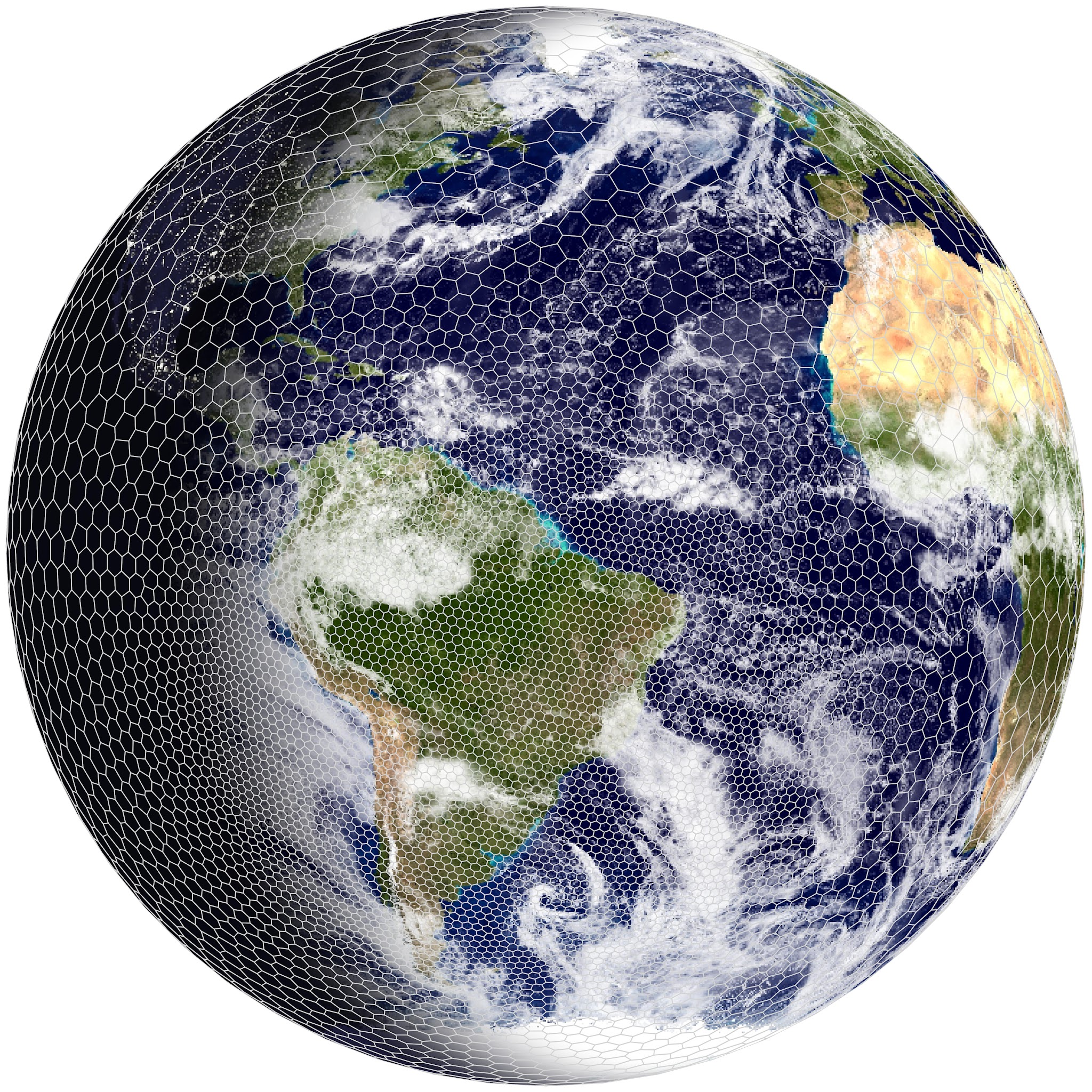
November 2026 · Politecnico di Milano
Atmosphere and Ocean Dynamics
PhD course · Politecnico di Milano · 23 November – 3 December 2026
Prof. Dr. Pedro da Silva Peixoto
Applied Mathematics
Instituto de Matemática e Estatística
Universidade de São Paulo
Visiting Professor at MOX Lab
Politecnico di Milano
About me
- Pedro S. Peixoto
- Applied Mathematics, Instituto de Matemática e Estatística (IME), Universidade de São Paulo, Brazil
- Visiting Professor at MOX, Politecnico di Milano
- Research: numerical methods for weather and climate models
Contact
Office: Building 14 (Nave)
2nd floor, room 30b, Campus Leonardo
The course
- Doctoral Programmes in Mathematics and Its Applications and in Environmental and Infrastructure Engineering
- 5 CFU · 8 sessions, 9:00–12:15
- Mon–Thu 23–26 November and Mon–Thu 30 November–3 December 2026
- Aula Saleri, 6th floor, Building 14 (Nave), Campus Leonardo
- Background: vector calculus, linear algebra, basic programming
- Practical work in Python (Jupyter notebooks)
Mathematical foundations, models and numerical methods for the large-scale dynamics of the atmosphere and the ocean
Programme
| Day | Date | Topic |
|---|---|---|
| 1 | Mon 23 Nov | A historical overview of atmosphere and ocean dynamics |
| 2 | Tue 24 Nov | The equations of motion from basic principles |
| 3 | Wed 25 Nov | Reduced models: scales, balance and waves |
| 4 | Thu 26 Nov | The vertical slice: buoyancy, convection and mountain waves |
| 5 | Mon 30 Nov | Finite differences: time stepping, advection, stability |
| 6 | Tue 1 Dec | Finite volumes: conservation; tides in the Adriatic |
| 7 | Wed 2 Dec | Spectral methods and the ECMWF model; finite elements with Firedrake |
| 8 | Thu 3 Dec | Modern weather, ocean and climate models; data-driven forecasts and AI models |
Every session: 9:00–12:15, with a break.
Assessment (Valutazione)
- Notebooks: in Google Colab from the course page (with a personal Google account), or downloaded and run on your computer (Python with numpy, scipy, matplotlib)
- Hand in by email to ppeixoto@usp.br by Friday 11 December
- Hand in the
.ipynbfile with your name at the end of its name, e.g.01-hadley-rossby-NameSurname.ipynb - For each notebook, every mandatory exercise (❗) should be solved
- Choose 3 of the 8 notebooks of lectures 1–4
- Choose 5 of the 14 of lectures 5–10
- Grade A: at least 8 notebooks solved, on time
- Hand in the
- Course page, with slides, notes and notebooks: www.ime.usp.br/~pedrosp/courses/polimi-cgfd; mirror: pedrospeixoto.github.io/polimi-cgfd
AI: The notebook exercises are meant to be easy and instructive: you should not need an AI to solve them. Use AI as a guide or an assistant, not to build your solutions.
References
Dynamics
- Vallis, Atmospheric and Oceanic Fluid Dynamics, 2nd ed., Cambridge, 2017
- Cushman-Roisin & Beckers, Introduction to Geophysical Fluid Dynamics, Academic Press, 2011
- Holton, An Introduction to Dynamic Meteorology, 4th ed., Elsevier Academic Press, 2004
- Gill, Atmosphere–Ocean Dynamics, Academic Press, 1982
- Majda, Introduction to PDEs and Waves for the Atmosphere and Ocean, AMS, 2003
Numerical methods and models
- Durran, Numerical Methods for Fluid Dynamics, Springer, 2010
- LeVeque, Finite Volume Methods for Hyperbolic Problems, Cambridge, 2002
- Lauritzen, Jablonowski, Taylor & Nair (eds.), Numerical Techniques for Global Atmospheric Models, Springer, 2011
- Döös, Lundberg & Aldama-Campino, Basic Numerical Methods in Meteorology and Oceanography, Stockholm University Press, 2022
- Randall, An Introduction to Numerical Modeling of the Atmosphere, course notes (AT604), 2011
- Kalnay, Atmospheric Modeling, Data Assimilation and Predictability, Cambridge, 2003
Getting to know you
- Your name and doctoral programme
- Your research topic
- Your background: fluid dynamics? numerical methods? Python?
- What do you expect from this course?