November 2026 · Politecnico di Milano
Data-driven weather forecasts: assimilation, reanalysis and AI models
Atmosphere and Ocean Dynamics — Lecture 10
Prof. Dr. Pedro da Silva Peixoto
Applied Mathematics
Instituto de Matemática e Estatística
Universidade de São Paulo
Visiting Professor at MOX Lab
Politecnico di Milano
From 1950 to today: the forecast chain
- 1950: one equation, one layer, 736 km, North America
- Today: the whole globe, ~10 km, ~100 levels, ocean, land, ice, an ensemble of forecasts
- Skill: about one day per decade: a 6-day forecast today is as good as a 5-day forecast ten years ago
But: where does the initial state come from?
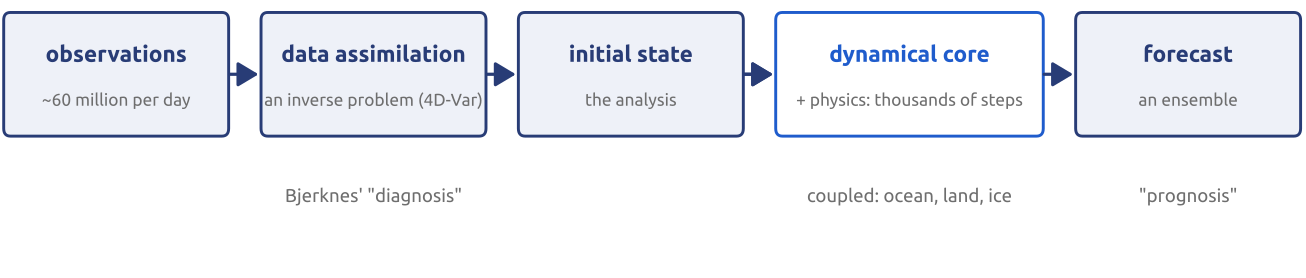
Bjerknes’ programme, industrialized: observe, assimilate, integrate the laws, many times over
(Bauer et al. 2015; Kalnay 2003)
Observations: the global observing system
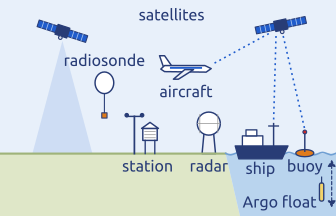
- Every day ECMWF receives about 800 million observations; about 60 million pass quality control
- Satellites (about 90 instruments) give most of them: radiances for temperature and humidity, GNSS radio occultation, winds from tracked clouds and, over the sea, scatterometers
- In situ: stations, radiosondes, aircraft, ships, buoys, Argo floats: direct and local; they anchor the analysis and expose satellite biases
But: irregular, mostly indirect, and short of winds. How do they become a state on the grid?
Satellites give the numbers, in situ observations the anchor; neither is a model state
(Modigliani et al. 2026) · Figure: after wmo.int: Global Observing System
Data assimilation: an inverse problem
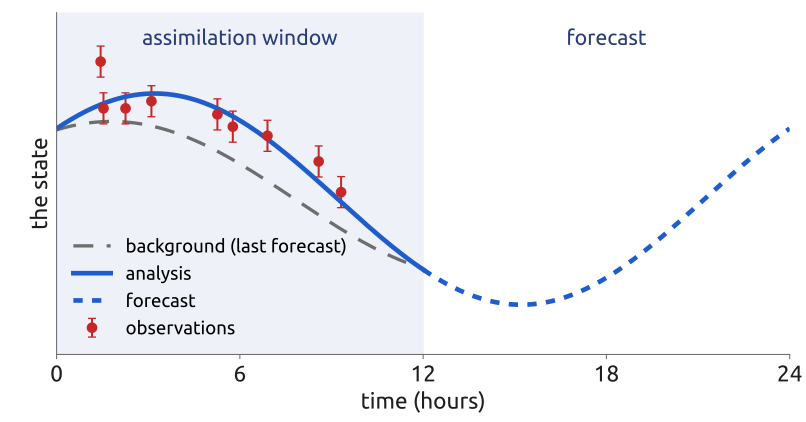
- The observations: irregular in space and time, mostly indirect (radiances, not winds)
- 4D-Var: find the initial state whose model trajectory best fits the observations and the last forecast (the background)
- It needs the model (and its adjoint); centres now mix it with ensembles (hybrid)
- Much of the skill gained in 40 years came from better analyses
But: how is the best fit found, with about \(10^9\) unknowns?
The initial state is the solution of an inverse problem, with the model inside
(Kalnay 2003, Sect. 5.6)
4D-Var: a minimization problem
\[ J[x(t_0)] = \underbrace{\tfrac12\,[x(t_0)-x^b]^{\mathsf T}\mathbf B_0^{-1}[x(t_0)-x^b]}_{J_b\text{: misfit to the background}} + \underbrace{\tfrac12\sum_{i=0}^{N}[H(x_i)-y^o_i]^{\mathsf T}\mathbf R_i^{-1}[H(x_i)-y^o_i]}_{J_o\text{: misfit to the observations}}, \qquad x_i = M(t_0, t_i)[x(t_0)] \] \(t_0,\dots,t_N\): observation times in the window; \(x(t_0)\): initial state (the unknown); \(x_i = x(t_i)\); \(x^b\): background (last forecast); \(y^o_i\): all observations at \(t_i\); \(H\): observation operator (state → measured, e.g. radiances); \(M(t_0, t_i)\): the model run from \(t_0\) to \(t_i\); \(\mathbf B_0\), \(\mathbf R_i\): error covariances
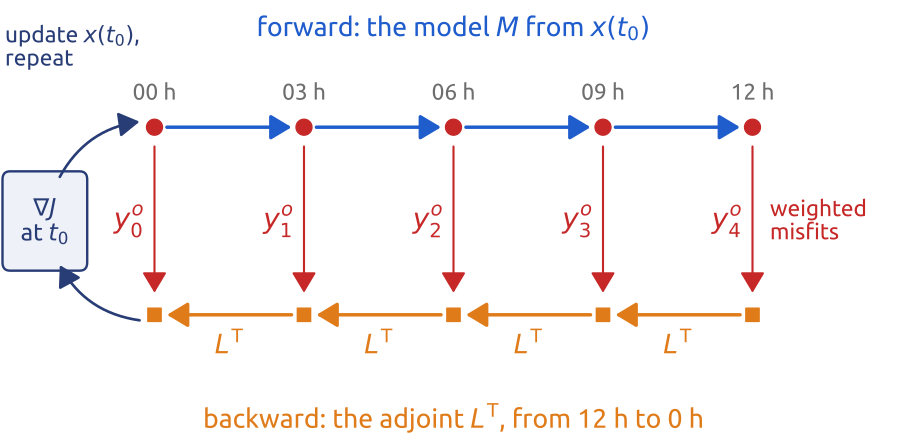
- Gradient: the model forward, its adjoint \(L^{\mathsf T}\) backward (\(L\): the linearized model); a quasi-Newton step; repeat
- Strong constraint: the analysis is a model trajectory, balanced; the model is taken as perfect
- Incremental: inner loops at lower resolution
But: a reanalysis needs decades of such analyses. With which model?
4D-Var: the model trajectory that best fits the last forecast and the observations
(Kalnay 2003, Sect. 5.6.3, eqs. 5.6.14–5.6.20, Fig. 5.6.2)
A reanalysis: decades of the past with one model

- An analysis is the initial state of one forecast; a reanalysis repeats the analyses of the past, every day of decades, with one frozen model and one assimilation system
- ERA5 (ECMWF, Copernicus): 1940 to today, hourly, \(0.25^\circ\) (about 31 km), 137 levels, about 5 PB; 4D-Var with the IFS of 2016 (cycle 41r2). Few observations before the satellites (1979)
Download it: free (CC BY 4.0) from the Copernicus Climate Data Store, cds.climate.copernicus.eu: ERA5 on single levels · ERA5 on pressure levels; from Python with cdsapi
The best estimate of the past atmosphere: one model and all the observations, together
(Hersbach et al. 2020; Bauer et al. 2015) · Data: (Copernicus Climate Change Service 2018b, 2018a)
ERA5 as training data
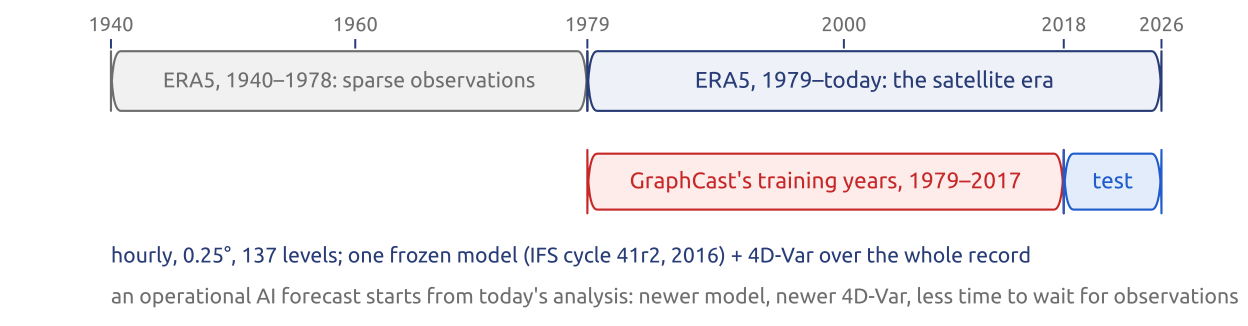
- Circular: made by the model being replaced: “AI beats IFS” partly means “AI matches a 2016 IFS”
- Not homogeneous: few observations before the satellite era; the constellation keeps growing
- Not available in real time: ERA5 uses observations up to about 9 h after each time; an operational analysis gets about 3 h: trained on one, run on the other
- Training data = truth: AI models are scored against ERA5, the IFS against its own analysis
A learned model is only as good as the reanalysis it learns from, and that reanalysis is physics
(Hersbach et al. 2020; Lam et al. 2023)
A new revolution: data-driven forecasts
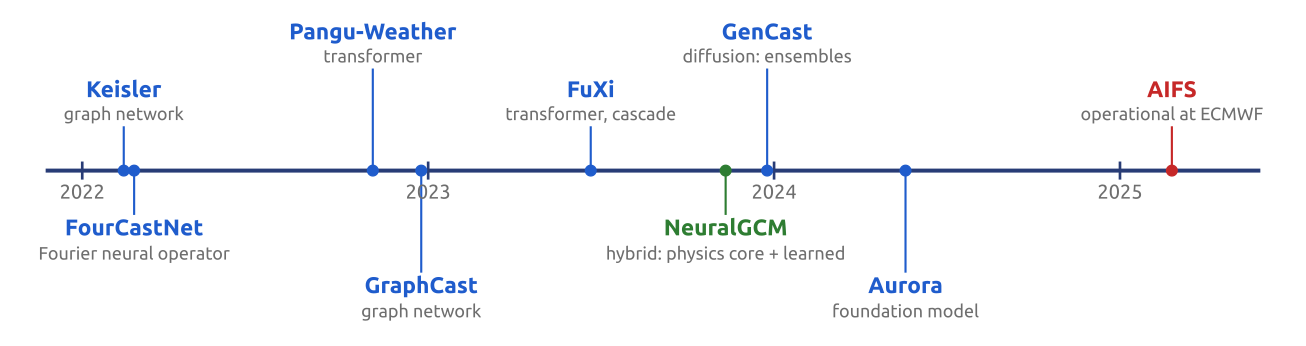
For a century, since Richardson, every forecast discretized the equations of motion. Since 2022 (first preprints on the timeline), models learned from data rival the best physics-based forecasts; on 25 February 2025 ECMWF made its AI model, AIFS, operational.
But: what exactly do they learn?
In three years, learned models went from a preprint to an operational forecast
(Lam et al. 2023; Bi et al. 2023; Lang et al. 2024)
What is learned, and from what
\[x^{n+1} = \Phi_\theta\!\left(x^{n}, x^{n-1}\right), \qquad \theta = \arg\min_\theta \sum_n \bigl\|\Phi_\theta(x^n, x^{n-1}) - x^{n+1}\bigr\|^2\]
\(x^n\): the whole state at time \(n\) (all variables, all points); \(\Phi_\theta\): the network, with parameters \(\theta\)
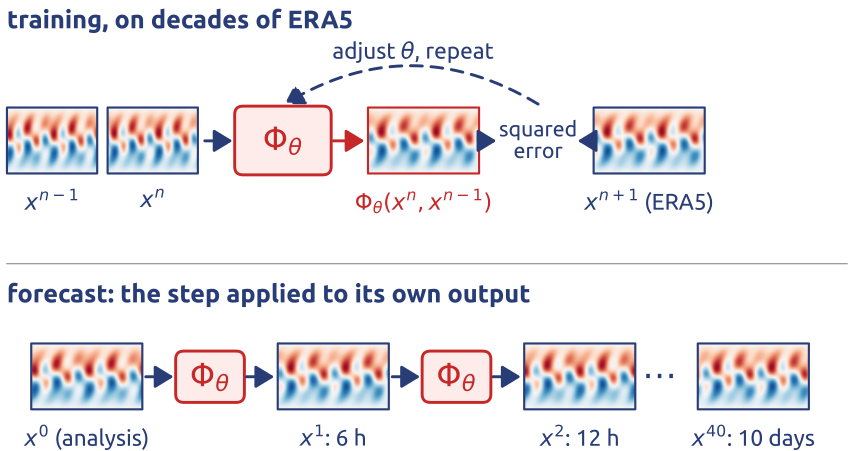
- One 6-hour step, fitted to pairs of states; a 10-day forecast composes it 40 times
- Trained on ERA5 (1940–today, 0.25°, 137 levels, hourly), made by the physics model and 4D-Var
But: what does \(\Phi_\theta\) look like inside?
One box of the chain replaced: the model is learned, the initial state still comes from physics
(Hersbach et al. 2020; Lam et al. 2023)
Five families of learned models
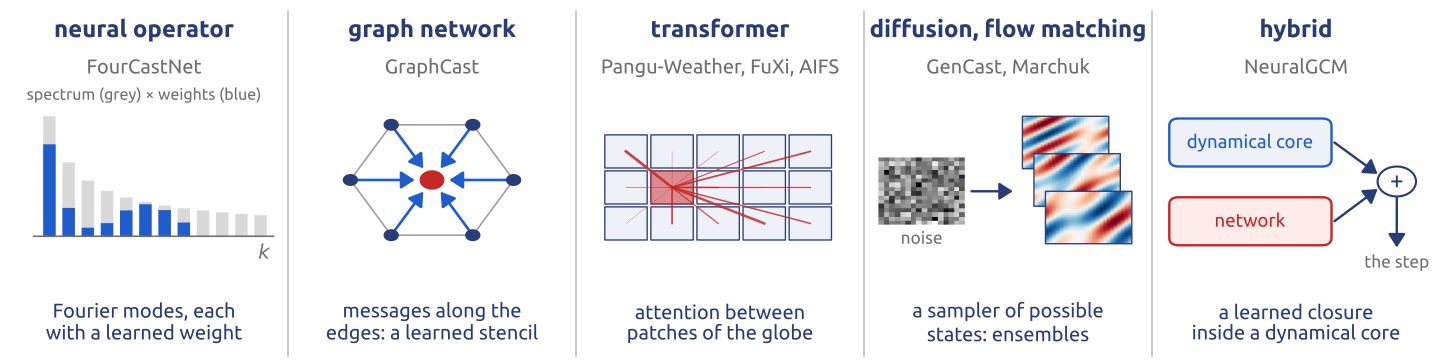
- What disappears: the grid as an approximation, the CFL time-step limit, every conservation law
- What survives: the state vector, and the initial state from 4D-Var
Different networks, one task: a map from the state now to the state 6 hours later
(Pathak et al. 2022; Lam et al. 2023; Bi et al. 2023; Chen et al. 2023; Lang et al. 2024; Price et al. 2025; Kochkov et al. 2024)
Inside a learned model: GraphCast
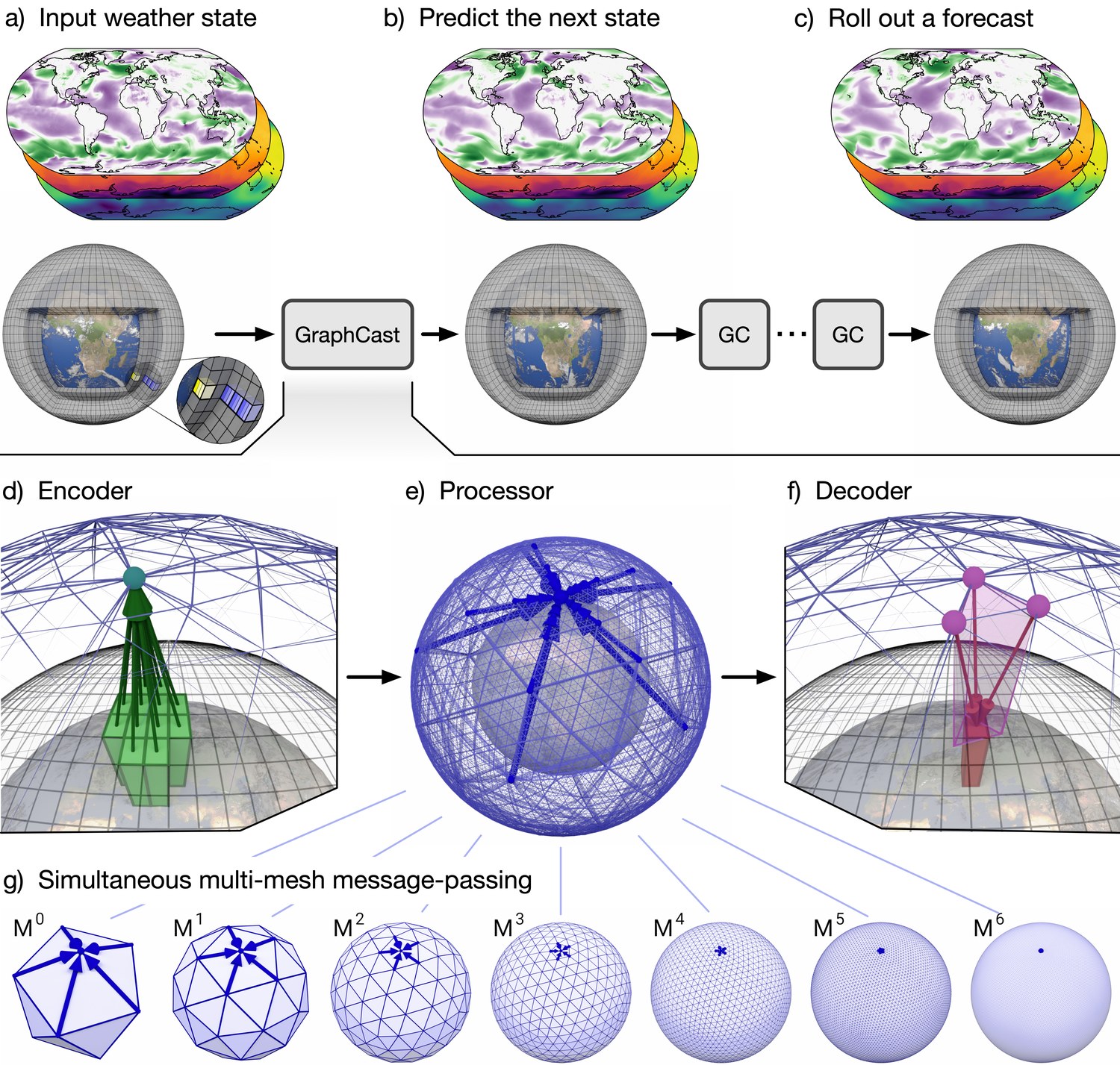
Lam et al. (2023), Fig. 1, CC BY 4.0
- (a–c) State → next state → forecast: 227 variables on the 0.25° grid (5 at the surface, 6 on 37 levels); GraphCast applied again and again
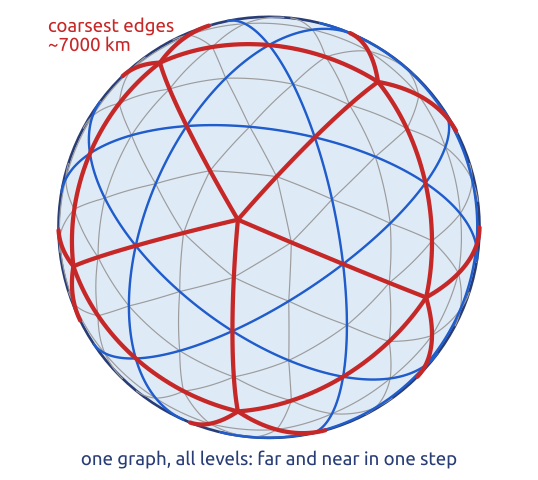
- (d) Encoder: the grid → a mesh of icosahedra, refined 6 times
- (e) Processor: 16 rounds of messages along the edges
- (f) Decoder: back to the grid: the change in 6 hours
- (g) Multi-mesh: the edges of all 7 meshes at once: near and far
36.7 million parameters; trained on ERA5 1979–2017, rollouts of 1 to 12 steps; about 4 weeks on 32 TPUs. A 10-day forecast in under a minute on one TPU (the IFS: about an hour on a supercomputer)
But: CFL forbids explicit steps of 6 hours on a 28 km grid. How can it?
Grids are back: a learned operator on an icosahedral mesh, as in finite volumes
(Lam et al. 2023; Keisler 2022) · Figure: arxiv.org/abs/2212.12794
One box replaced
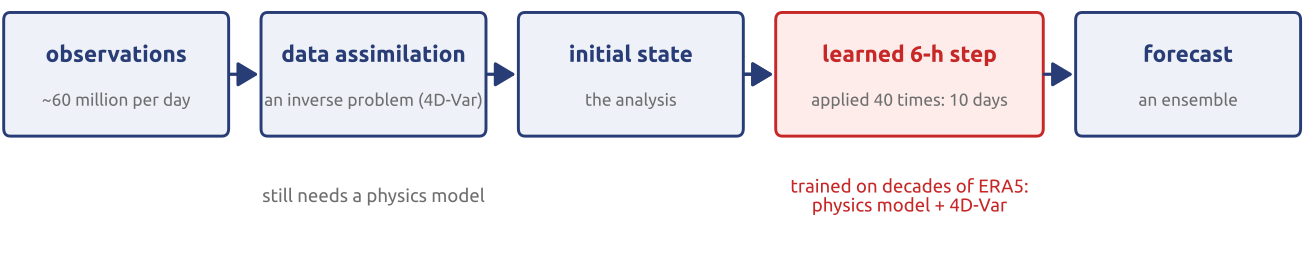
- Still needs physics to run: the initial state comes from 4D-Var, and 4D-Var needs a model (and its adjoint)
- Training data needs a physics model: ERA5 is IFS + 4D-Var
- Resolution is not the metric: AIFS at 28 km beats the IFS at 9 km on many scores
- The physics–dynamics split is gone: dynamics and parameterizations are learned together; neither can be inspected or swapped
The learned step replaces the model; observations, assimilation and reanalysis remain
(Lang et al. 2024; Hersbach et al. 2020; Bauer et al. 2015)
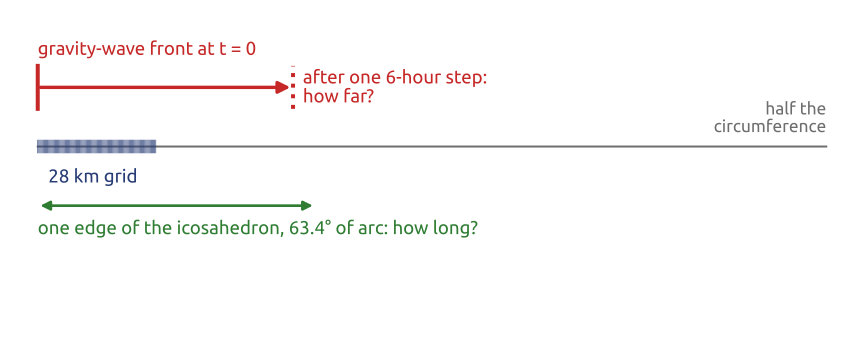
Example: how can an AI model take a 6-hour step?
- How far does a gravity wave travel in 6 hours at 300 m/s? How many explicit steps would a 28 km grid need for those 6 hours (CFL)?
- The learned model takes one step: how far apart are the two ends of an edge of the icosahedron (\(63.4^\circ\) of arc), the coarsest edges of GraphCast’s mesh?
- And for a step of 24 hours, with the jet stream (100 m/s) and the gravity waves?
(Lam et al. 2023; Courant et al. 1928)
What the example shows
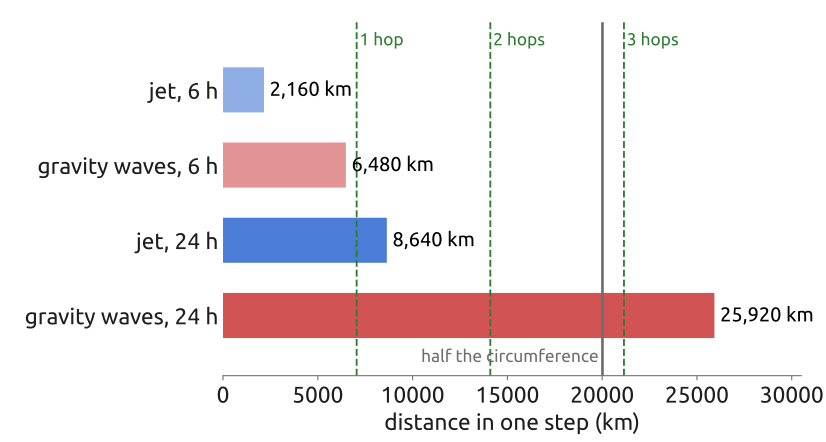
- In 6 hours a gravity wave travels 6480 km; an explicit model on a 28 km grid needs about 230 steps of 93 s (CFL)
- One edge of the icosahedron, \(63.4^\circ\) of arc: 7050 km, longer than the domain of dependence of a 6-hour step. Only 12 hub nodes have such edges; a typical node reaches them in a few hops (edges of 110, 220, 450 … km), well within the 16 rounds of message passing
- A 24-hour step: 8640 km for the jet, 25 900 km for gravity waves, more than half the globe: a global receptive field
A learned step is a stencil: it must reach as far as the fastest signal travels in one step
(Lam et al. 2023; Courant et al. 1928)
Do they work? Yes, mostly
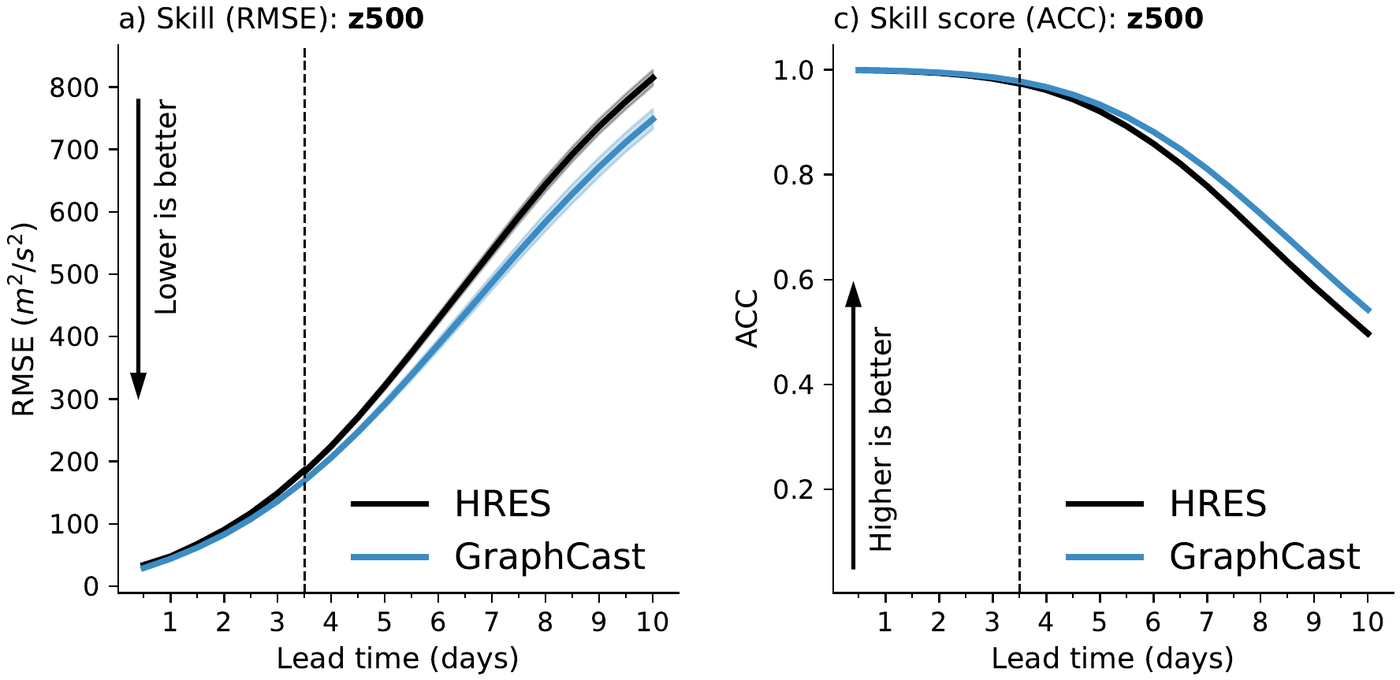
GraphCast (blue) and ECMWF’s HRES (black), 500 hPa geopotential, forecasts of 2018: error (RMSE, m²/s²) and anomaly correlation (ACC) against lead time; shading: 95% intervals. Lam et al. (2023), Fig. 2a, c, CC BY 4.0
What works
- GraphCast beat HRES on 90% of 1380 targets; GenCast (diffusion) beat the ECMWF ensemble on 97% of 1320
- AIFS, at 28 km, beats 9 km physics-based models on many scores (2026); about 1000 times less energy per forecast
What does not, yet
- Blurring: trained on the mean-square error, they forecast the average of the possible futures
- Extremes are rare in the data; no conservation laws by construction
- They need 4D-Var and a reanalysis; the climate of the training years
Excellent average forecasts; extremes, conservation and the physics they rest on remain open
(Lam et al. 2023; Price et al. 2025; Rasp et al. 2024; Ben Bouallègue et al. 2024; Moldovan et al. 2026) · AIFS: ecmwf.int · Figure: arxiv.org/abs/2212.12794
What AI models cannot do, yet
- Extremes: record-breaking heat, cold and wind are forecast better by physics-based models; extremes are rare in the data, and the mean-square error pulls towards the mean
- Blurring: the best mean-square forecast is the average of the possible futures; fronts and storm centres are smoothed
- No conservation laws: nothing enforces mass or energy; long runs drift
- Circular data: ERA5 is a physics product, not available in real time
- A changing climate: trained on the past (GraphCast: 1979–2017), used in the climate of today
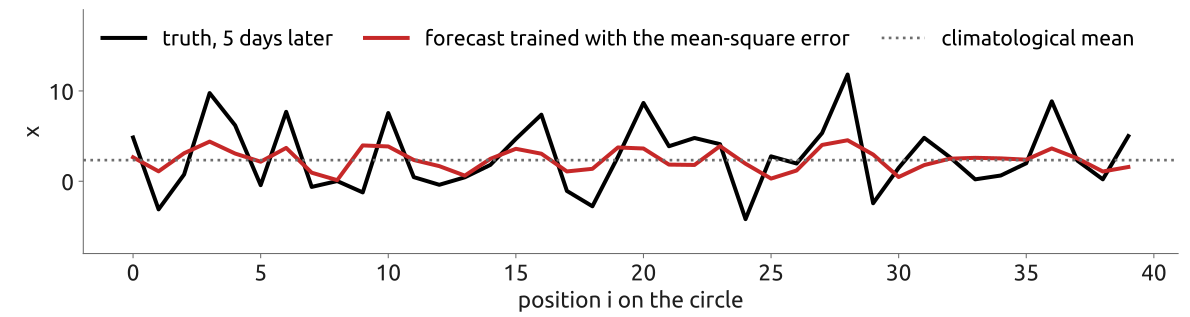
Blurring in the tiny AI model: a forecast trained on the mean-square error, 5 days ahead, loses the amplitude of the waves
Excellent on average; the rare, the extreme and the conserved still need physics models
(Zhang et al. 2026; Price et al. 2025; Kochkov et al. 2024)
The newest: learning the analysis too
4D-Var: the analysis is the model trajectory that best fits the background and the observations
- Every model so far starts from a physics-based analysis
- End to end: learn the map from the raw observations to the forecast, with no 4D-Var at run time: Aardvark Weather (Cambridge, Turing Institute, 2025), FuXi-Weather (Fudan, 2025)
- Still trained on reanalyses, and still behind the best operational systems on many scores
But: without a physics model anywhere, who checks the learned atmosphere?
The last box of the chain is being learned: from observations straight to the forecast
(Allen et al. 2025; Sun et al. 2025)
Where it is going: hybrids, and the world
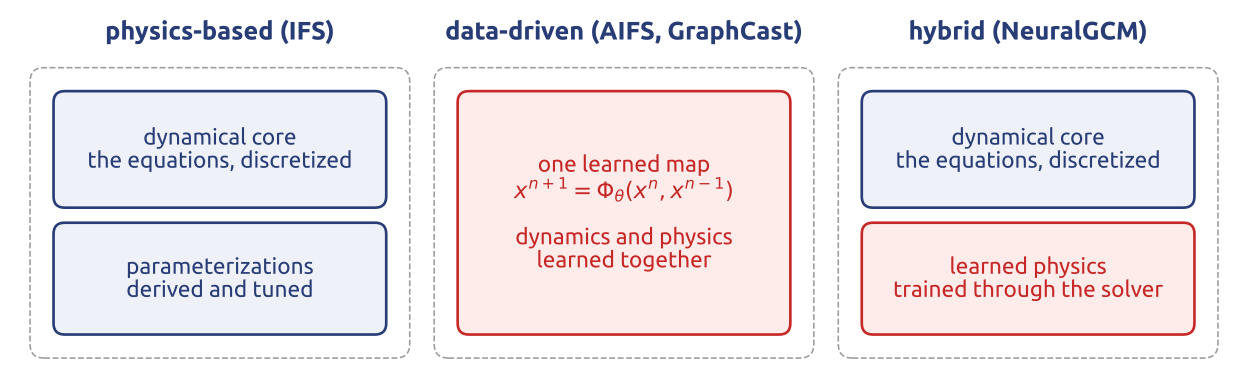
- Hybrid: NeuralGCM keeps a differentiable spectral core and learns the unresolved physics: the equations come back
- Foundation models: Aurora, one network fine-tuned to weather, air quality, ocean waves
- Ensembles: diffusion models (GenCast, FuXi-ENS) sample possible futures instead of averaging them
The likely future: physics and learning together, not one replacing the other
(Kochkov et al. 2024; Bodnar et al. 2025; Price et al. 2025; Zhong et al. 2025)
Notebook A tiny AI weather model
Notebook 10a (open in Colab · download): train and run an AI weather model on a laptop, in numpy.
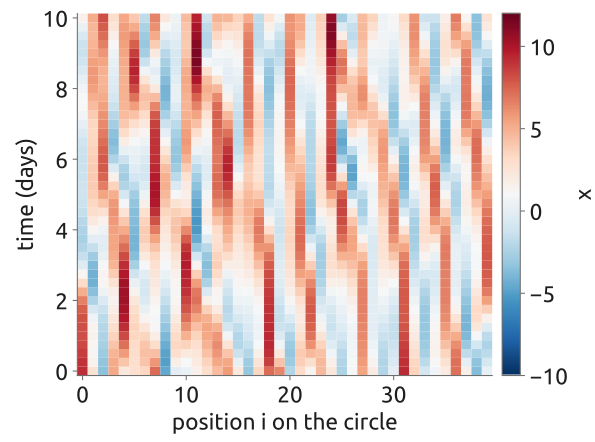
Lorenz-96: an “atmosphere” of 40 numbers around a latitude circle
- Lorenz-96: an “atmosphere” of 40 numbers, chaotic
- A “reanalysis”: 11 years of 6-hourly states
- Learn the 6-hour step: linear, then a small network with a local stencil
- Forecast by composing the step ❗ 4.1
- Why a learned forecast blurs
Predict, run, explain: which forecasts better, the linear model or the small network?
Train and run an AI weather model on a laptop, in numpy
(Lorenz 1996; Lam et al. 2023)
What the notebook showed
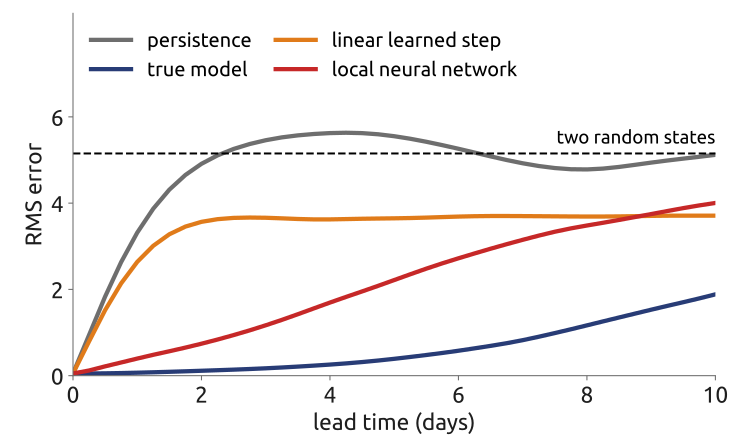
- The local network (1300 parameters) beats the linear model (1640): it learns the dynamics, a stencil like a finite difference
- Its stencil must cover where information comes from in one step: CFL, learned
- Nothing beats the true model from a slightly wrong start for long: chaos
A learned step is a numerical method whose coefficients were fitted instead of derived
(Lorenz 1996)